Every year, owners surrender or rehome cats over destroyed couches and shredded carpet. It's a tragedy built on a misunderstanding: scratching is not spite, boredom, or bad behavior. It's one of a cat's core maintenance behaviors, and it can be redirected in days once you understand what your cat is actually doing.
Four Reasons Every Cat Scratches
1. Claw maintenance
Cats shed the outer sheath of their claws as they grow. Scratching loosens and removes the old layer — you've probably found these translucent crescents around your cat's post. Without a scratching surface, claws overgrow and snag.
2. Scent marking
Cat paws contain scent glands. Scratching deposits the cat's signature scent where other animals — and the cat itself — will find it. This is why cats often scratch the same spot repeatedly: they're refreshing a message.
3. A full-body stretch
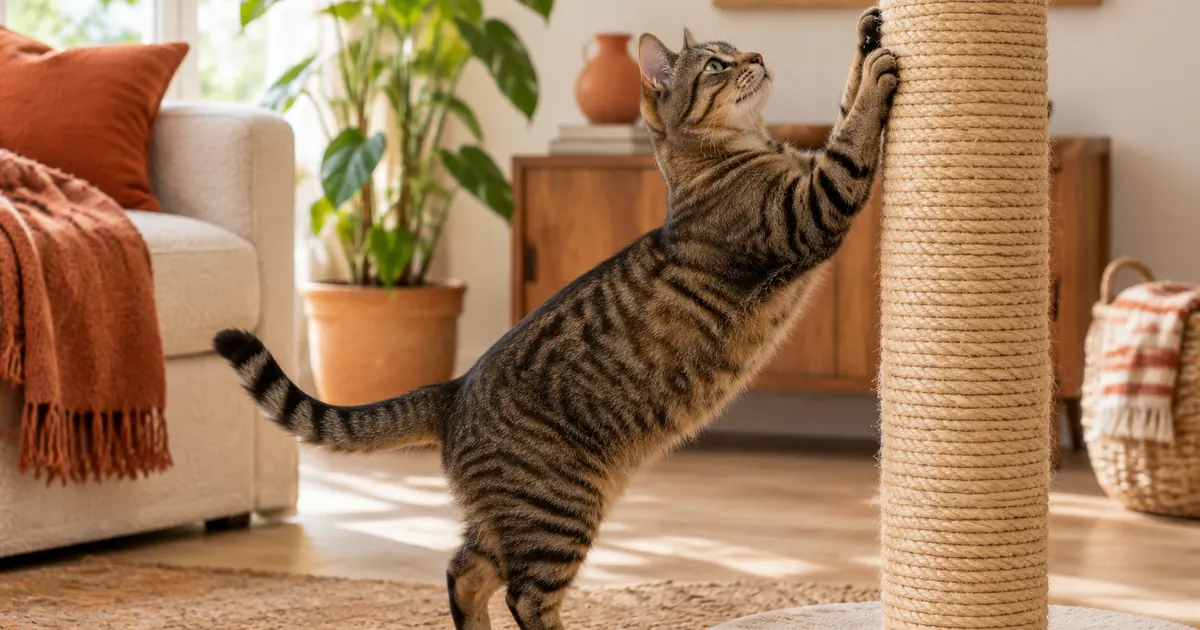
Watch a cat scratch a tall post: front claws grip, back legs extend, spine arches. It's a yoga sequence they perform dozens of times a day. Vertical surfaces let them stretch to full length; that's why tall space-saving sisal posts outperform short ones for most adult cats.
4. Stress relief and territory confidence
In multi-cat homes, scratching builds a shared scent landscape that reduces tension. Cats in new environments scratch more — it's self-soothing.
Choosing a Scratcher Your Cat Will Actually Use
Material: sisal wins
Sisal rope and sisal fabric closely mimic the texture of tree bark, the surface cats evolved to scratch. Sisal fabric posts with sturdy weighted bases resist shredding far longer than carpet-covered posts, and carpet can confuse cats about which textiles are fair game.
Stability: the number-one dealbreaker
A post that wobbles even slightly teaches your cat that it's unreliable — and the sofa, which never moves, wins. Check the base: it should resist tipping when the cat hangs their full weight from the top. This single factor explains most "my cat ignores the post" complaints.
Orientation: vertical and horizontal
Most cats prefer vertical scratching, but some — especially seniors with stiff joints — favor horizontal surfaces. Offering both covers every preference. Recycled cardboard scratchers are inexpensive horizontal options that double as loungers.
Beyond the Post: Climbing as Enrichment
Cats live vertically. In the wild, height means safety and a vantage point for hunting. Indoor cats without vertical territory are, in a real sense, under-stimulated.
Wall shelves
Wall-mounted shelves with carpeted tops let you build a climbing route along any wall. Place them 12–16 inches apart vertically so cats can ascend in easy hops, and end routes at a window — the feline equivalent of television.
Cat trees
A multi-level cat tree with a sturdy base combines climbing, scratching, and perching in one footprint. Position it near a window and in a room where the family spends time — cats want altitude and company.
Outdoor access, safely
For supervised outdoor time, a weatherproof PVC catio gives cats fresh air, birdsong, and sunshine without the risks of free roaming — outdoor cats live dramatically shorter lives on average.
The 7-Day Redirect Plan
- Days 1–2: Place the new post next to the furniture your cat targets. Stability check: push it hard; it shouldn't rock.
- Days 2–4: Sprinkle catnip on the base or dangle a toy from the top. Reward any use with treats.
- Days 4–7: Move the post a few feet per day toward its permanent spot — ideally near your cat's favorite resting area, not hidden in a corner.
- Throughout: Make the off-limits furniture unattractive: double-sided tape strips or a light citrus spray.
Common Mistakes That Undo Good Intentions
Hiding the scratcher in a corner
Owners place posts where they look tidy — spare rooms, hallway ends. Cats scratch where they already spend time. A post in a dead corner is furniture for nobody; a post beside the sofa being targeted is a strategic intercept.
Declawing confusion
Declawing is not a nail trim — it amputates the last bone of each toe and is opposed by every major veterinary association. Cats redirected to proper scratchers never need it discussed.
Punishing the cat
Scolding a cat for scratching teaches them to do it when you're absent, not to stop. Redirection plus attractive alternatives is the only approach that survives contact with actual cat psychology.
When to Add More Scratchers
Multi-cat households need multiple stations — the rule of thumb is one per cat plus one, spread across different rooms. If your cat suddenly changes scratching habits, especially scratching walls low to the ground, a vet visit is worthwhile: sometimes it signals stress or, rarely, medical issues.
The Takeaway
You will never stop a healthy cat from scratching, and you shouldn't try. Give them a surface that's taller, sturdier, and more satisfying than your furniture, put it where they actually spend time, and reward use. Browse our cat furniture and scratchers collection to find posts, shelves, and trees built around those three principles.